
Traditional marketing has helped financial institutions build brand awareness, reach broad audiences, and maintain relationships for decades.
Finastra’s 2026 Financial Services State of the Nation Survey found that 38% of financial institutions identified improved service and personalized experiences as their customers’ top demand.
This is where AI marketing for financial institutions becomes increasingly relevant. Rather than relying only on broad audience segments and scheduled campaigns, AI can help institutions analyze data, recognize individual preferences, and deliver more timely, personalized communication.
Let’s understand what it is, how it works, how it benefits with some relevant examples.
Summary
- Traditional marketing relies on broad audience segments, scheduled campaigns, and manual performance analysis.
- AI marketing for financial institutions uses data and predictive analytics to identify patterns, understand financial interests, and improve audience targeting.
- AI-powered marketing enables more personalized communication based on customer preferences and engagement behavior.
- Financial institutions can use AI in financial services to improve campaign optimization, support retention efforts, allocate marketing budgets, and measure outcomes.
- AI does not replace traditional marketing. It strengthens financial services marketing by making campaigns more relevant, responsive, and data-driven.
What Is AI-Powered Marketing for Financial Institutions?
AI-powered marketing uses artificial intelligence, machine learning, and data analytics to help financial institutions make better marketing decisions and create more relevant communication.
Instead of relying entirely on predefined audience segments and campaign schedules, AI can analyze available data to identify patterns, understand behavioral signals, predict potential needs, and inform personalized marketing decisions.
Similarly, a credit union can use AI-driven marketing to better understand member engagement patterns and identify opportunities to make its communication more meaningful.
AI vs Traditional Marketing: Key Differences
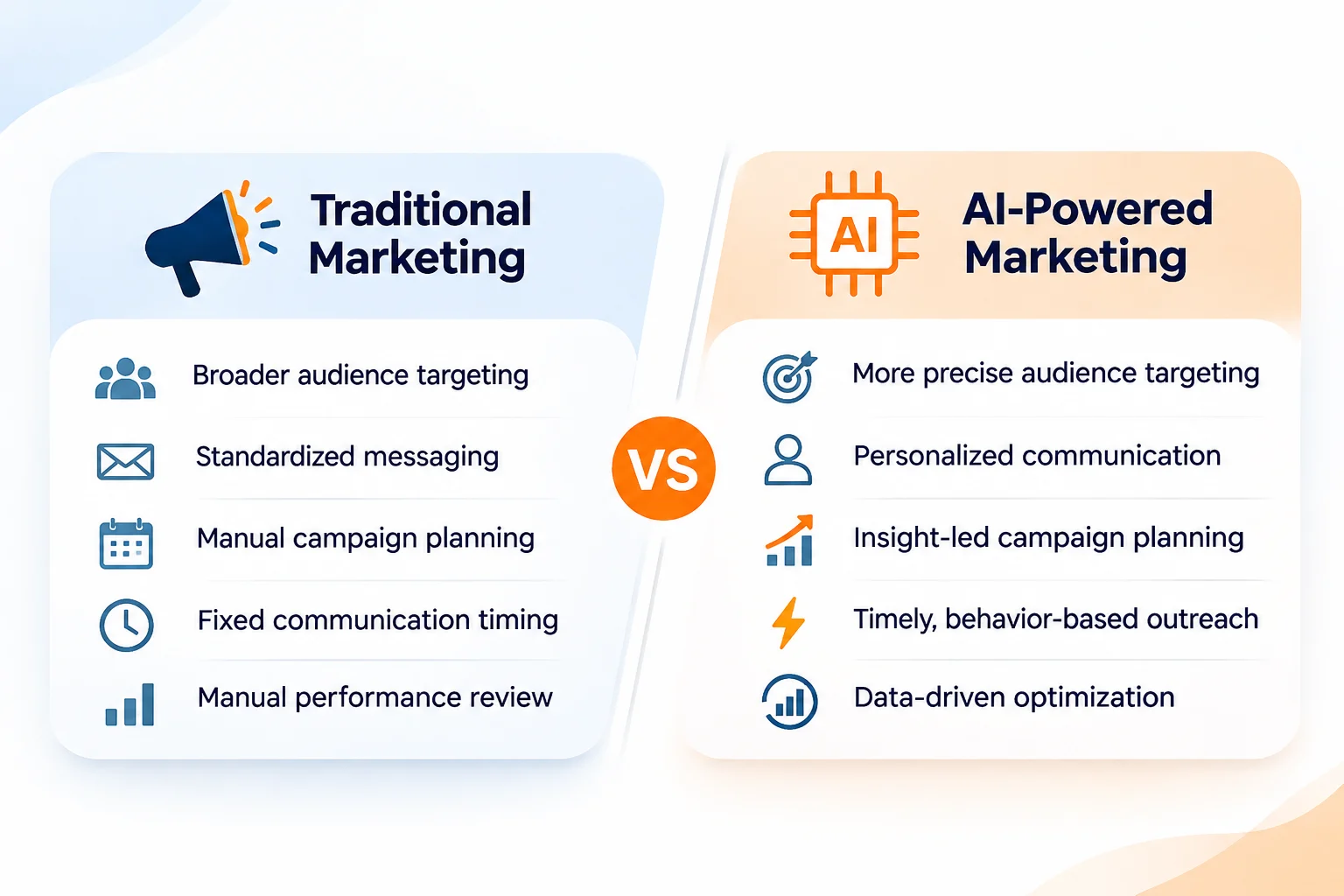
The biggest difference between traditional marketing and AI-powered marketing is how financial institutions use information to make marketing decisions.
Traditional marketing generally follows a campaign-first approach. Teams identify an audience, develop a message, distribute it, and review performance. AI-powered marketing adds a data-intelligence layer that helps institutions understand individual behavior for targeted communication and marketing.
Here is how the two approaches compare:
Comparison |
Traditional Marketing |
AI-Powered Marketing |
| Audience targeting | Relies on predefined demographic and behavioral segments. | Analyzes available data to identify more specific audience patterns and interests. |
| Personalization | Uses largely standardized messages for selected audience groups. | Supports individualized communication based on relevant preferences and behavioral signals. |
| Campaign planning | Relies on marketing calendars, historical results, and manual decisions. | Uses predictive insights to inform campaign planning and audience selection. |
| Communication timing | Follows predetermined campaign schedules. | Can help identify more relevant communication opportunities based on engagement signals. |
| Campaign optimization | Marketing teams review results and make manual adjustments. | AI can help identify performance patterns and inform campaign adjustments. |
| Performance measurement | Primarily evaluates completed campaign performance. | Can combine historical analysis with predictive insights to support future decisions. |
| Scalability | Expanding personalized campaigns often requires additional manual effort. | Can support personalization across larger audiences, depending on the technology and data infrastructure. |
| Decision-making | Relies heavily on marketing experience and historical reporting. | Combines human expertise with data-driven and predictive insights. |
What Does This Difference Look Like in Practice?
Consider a credit union promoting a new savings product.
With traditional marketing, the team might create a campaign targeting members within a particular age group or account category. Everyone in that segment receives the same email, highlighting the product’s interest rate, benefits, and account-opening process.
The campaign reaches its intended audience, but it does not necessarily account for differences in individual financial interests.
With AI marketing for financial institutions, the process can be more specific.
For example, the credit union could analyze permitted first-party data, including:
- Previous interactions with savings-related emails and website pages.
- Responses to earlier deposit account campaigns.
- Digital banking activity, where appropriate and permitted.
- Existing product relationships and communication preferences.
AI can analyze these signals together to identify patterns that broad demographic segmentation might overlook.
Why Financial Institutions Are Adopting AI Marketing?
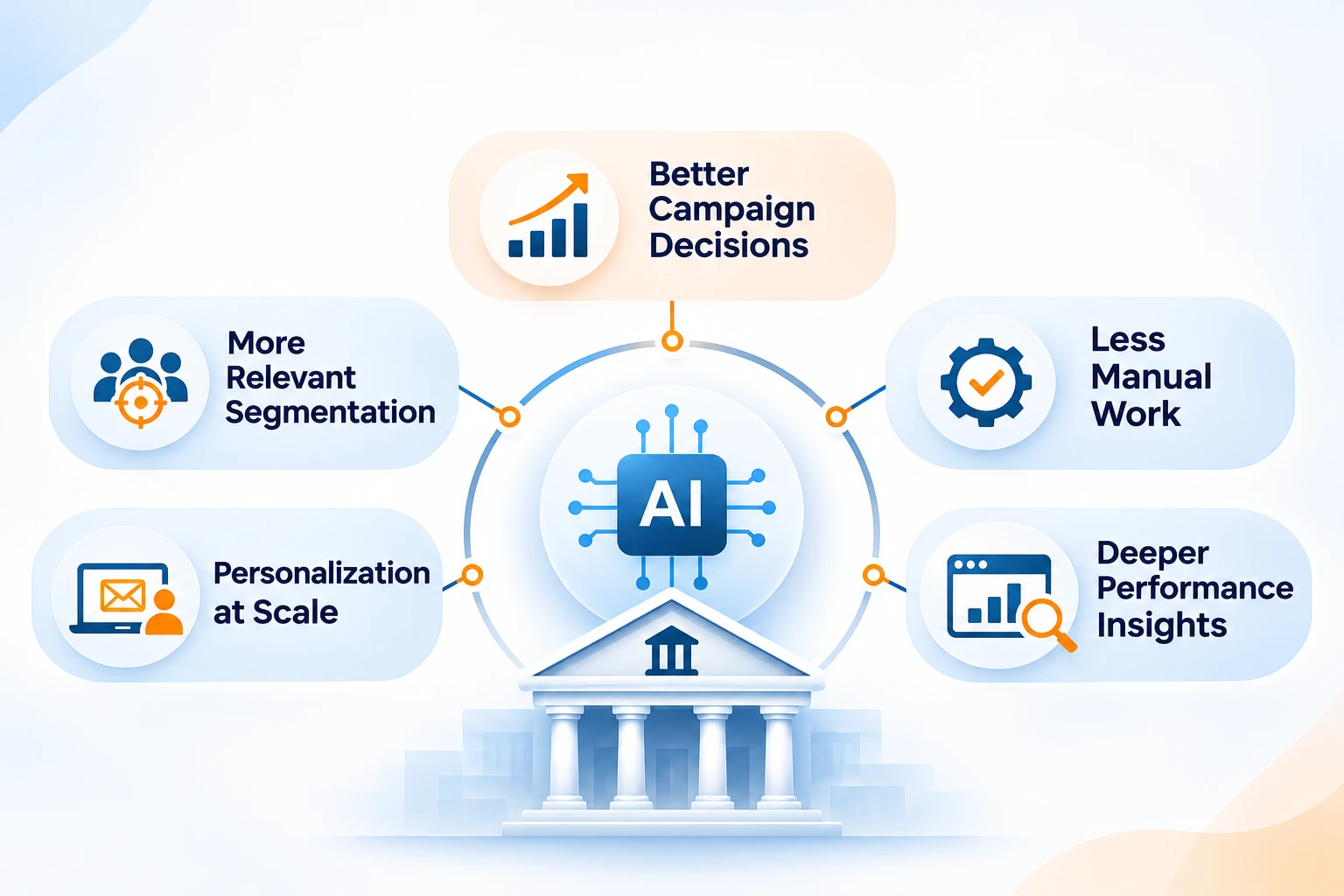
Financial institutions are adopting AI because traditional marketing processes alone are becoming insufficient for managing increasingly complex customer data, communication channels, and engagement expectations.
Several factors are driving this adoption.
Moving Beyond Broad Audience Segmentation
Traditional campaigns often group members and customers using factors such as age, location, income, or account type. While useful, these categories do not always reflect changing financial interests.
AI can help marketing teams analyze first-party data, including product interactions, previous campaign responses, and digital engagement patterns, to identify more meaningful audience segments.
Making Personalization More Practical at Scale
Personalized communication is valuable, but creating individual campaigns manually for thousands of members or customers is difficult.
AI personalization in financial services can help analyze individual engagement patterns and tailor messaging, content, and communication timing across larger audiences.
Improving Campaign Decisions With Predictive Analytics
Historical campaign reports explain what happened. But financial institution marketing teams also need to understand what they should do next.
Predictive analytics for financial institutions can help estimate the likelihood of certain outcomes using historical data and relevant behavioral signals.
Reducing Manual Marketing Work
Marketing teams spend considerable time preparing campaign content, organizing audience lists, reviewing performance reports, and coordinating communication across channels.
AI can support repetitive activities such as content drafting, campaign analysis, audience research, and reporting. This gives marketing teams more time to focus on campaign strategy, creative decisions, and relationship-building initiatives.
Measuring More Than Campaign Activity
Email opens, clicks, impressions, and website visits provide useful information, but they do not always explain whether marketing activity is contributing to meaningful business outcomes.
AI-powered analytics can help institutions examine relationships between campaign exposure, engagement patterns, and subsequent actions, such as product inquiries or account applications.
Challenges Financial Institutions Should Consider Before Adopting AI Marketing
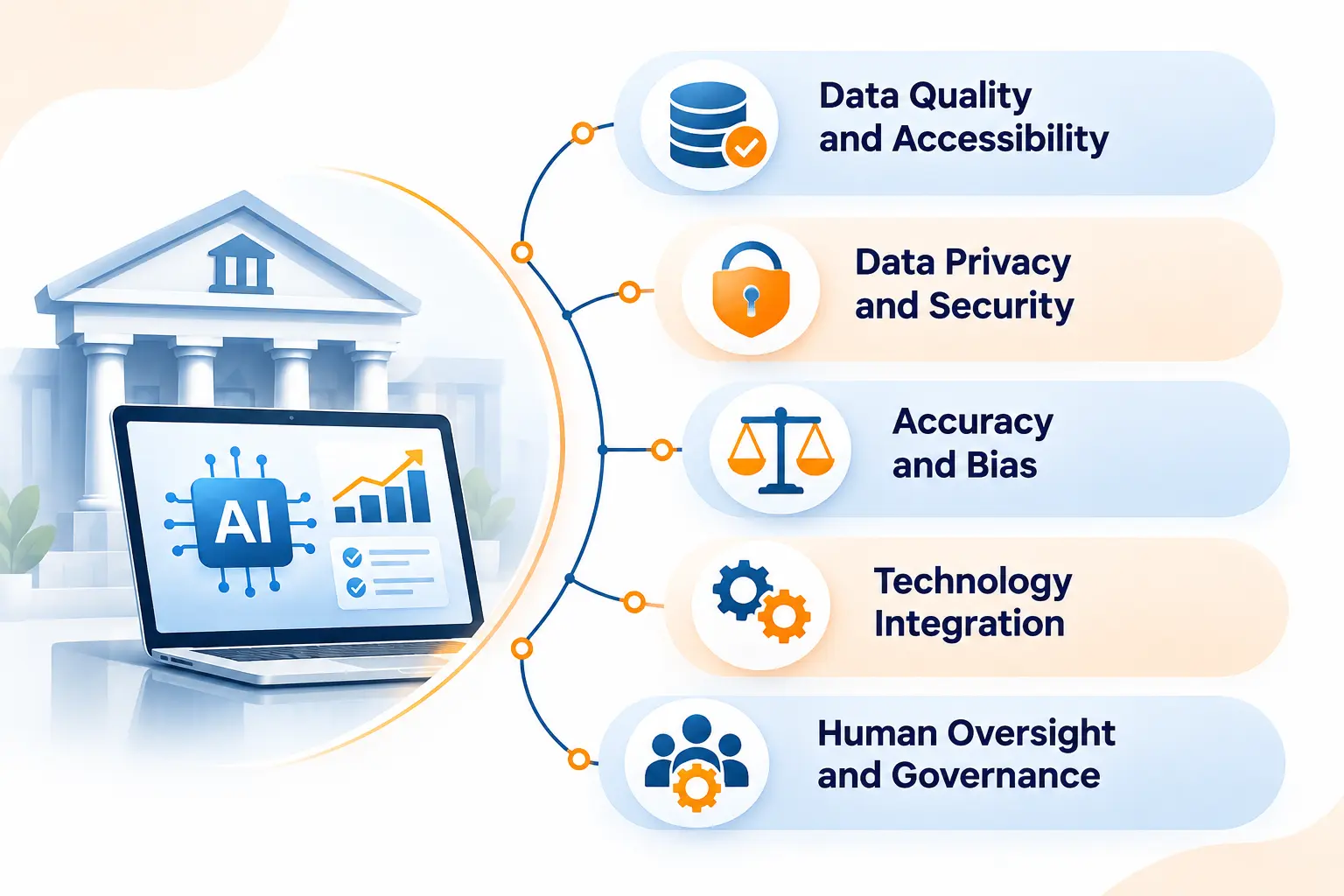
AI can improve marketing decisions, but financial institutions must address a few challenges before adopting it.
Data Quality and Accessibility
Incomplete, outdated, or disconnected data can lead to inaccurate audience insights. Institutions need reliable data sources and proper integration across their marketing and banking systems.
Data Privacy and Security
Financial institutions handle sensitive member and customer information. They must establish clear data access controls, consent practices, and safeguards when using third-party AI platforms.
Accuracy and Bias
AI recommendations can reflect biases in historical data or produce misleading insights. Marketing teams need to review outputs and monitor campaign outcomes for unfair targeting.
Technology Integration
An AI platform should work with existing CRM, email marketing, analytics, and digital banking systems. Poor integration can create disconnected workflows rather than improve marketing operations.
Human Oversight and Governance
AI should support marketing decisions, not replace accountability. Teams must review campaign recommendations, verify content, and ensure communication follows institutional policies.
The NIST AI Risk Management Framework and NCUA AI Resource Center offer useful guidance for managing these considerations.
How Financial Institutions Can Transition From Traditional to AI-Powered Marketing?
Adopting AI requires more than selecting a marketing platform. Financial institutions need to connect AI capabilities with specific business objectives, existing data, and the way members and customers interact with their services.
Here are five practical considerations when building an AI marketing strategy.
Start With a Specific Marketing Challenge
Identify where existing campaigns are falling short. For example, a credit union struggling with low savings account adoption could explore AI-driven audience analysis to identify members showing interest in savings products.
Connect Relevant Data Sources
Evaluate the information available across CRM platforms, email campaigns, digital banking channels, and product interactions. Bringing relevant data together helps AI identify patterns that isolated marketing reports might miss.
Prioritize Personalization and Predictive Insights
Choose AI capabilities that address actual marketing needs. Audience intelligence, predictive analytics, and individualized content recommendations can help institutions move beyond broad campaigns.
Test With a Focused Campaign
Start with one measurable initiative, such as a savings promotion, loan campaign, or member re-engagement program. Compare its performance against a traditional campaign to understand whether AI improves targeting, engagement, or conversions.
Establish Clear Performance Measures
Measure outcomes that connect marketing activity with institutional goals, including:
- Product inquiries and completed applications.
- New account openings and product adoption.
- Member and customer engagement.
- Campaign conversion rates.
- Marketing cost per acquisition.
- Retention and repeat engagement.
Financial institutions should also establish data access controls, compliance reviews, and human oversight before expanding AI initiatives.
How AiVantage Approaches AI-Powered Marketing?
Financial institutions already have valuable information about their members and customers. The challenge is connecting that information with meaningful marketing decisions.
This is where AiVantage brings a more connected approach to financial services marketing.
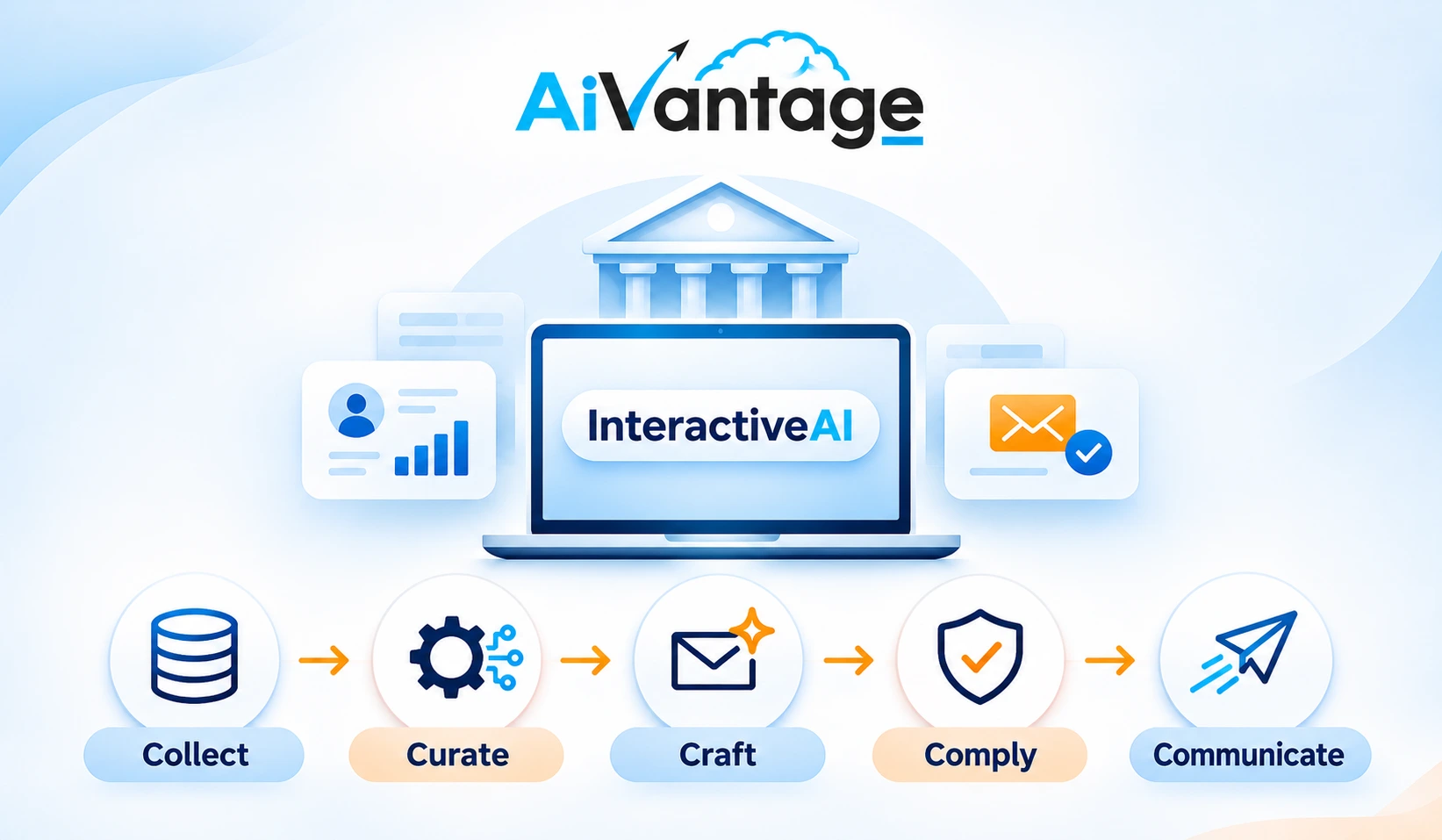
Its InteractiveAI platform is built around AI-powered 1:1 hyper-personalization. Rather than treating everyone within an audience segment the same way, it uses existing data and financial intelligence to help institutions create individualized communications.
The platform follows a five-step process:
- Collect: Gather relevant information from different data sources.
- Curate: Apply machine learning techniques to refine and organize the data.
- Craft: Use AI to create personalized email communications based on individual needs and opportunities.
- Comply: Support controlled and compliant communication through built-in checks.
- Communicate: Activate thousands of personalized messages at scale.
What Makes This Approach Different?
InteractiveAI connects financial intelligence with marketing execution. Its financial-services-specific templates, individual-level personalization, AI message creation, campaign activation, and engagement reporting help institutions move beyond conventional segment-based marketing.
The broader strategic value is connecting information, intelligence, and action. Instead of simply increasing campaign volume, financial institutions can work toward making every interaction more relevant.
Conclusion
The shift from traditional marketing to AI-powered marketing is not about replacing established channels. It is about making financial institution communication more relevant, informed, and measurable.
Traditional marketing remains important for brand awareness and relationship building. AI adds another layer by helping institutions connect data, identify opportunities, and personalize engagement at scale.
For banks and credit unions, the real opportunity lies in moving beyond campaign volume and focusing on the quality of every interaction. Platforms like AiVantage’s InteractiveAI can help bring that approach into practice through 1:1 hyper-personalization.
Ultimately, better marketing starts with the right tool and understanding the people behind the data.
Frequently Asked Questions
1. What is the main difference between AI and traditional marketing?
Traditional marketing relies on predefined audience segments, scheduled campaigns, and manual analysis. AI-powered marketing uses data and predictive insights to help financial institutions create more relevant, personalized communication and make informed campaign decisions.
2. How does AI improve marketing for banks and credit unions?
AI can analyze customer or Member data, identify engagement patterns, predict potential product interests, and help tailor communication. This can support more relevant campaigns, better audience targeting, and improved marketing decisions.
3. What are some examples of AI marketing in financial services?
Common applications include pers finalized product recommendations, Member or Customer retention campaigns, predictive campaign analytics, tailored financial education, and communication optimization across digital channels.
4. Is AI marketing suitable for small credit unions?
Yes. Smaller credit unions can explore AI marketing by starting with a specific challenge, such as improving savings product engagement or strengthening Member communication. The right approach depends on available data, technology, budget, and internal readiness.
5. How can financial institutions measure the success of AI marketing?
They can track relevant outcomes such as qualified inquiries, completed applications, product adoption, campaign engagement, retention, and conversion rates. The right measures depend on the campaign’s business objective.