
A customer receives a loan offer they do not need. A member gets another generic promotional email. Meanwhile, someone actively looking for a better savings option receives no relevant information from their financial institution.
This is a common challenge in financial services marketing. Institutions have access to customer and member data, but understanding what people need and when they need it is still difficult.
Highlights
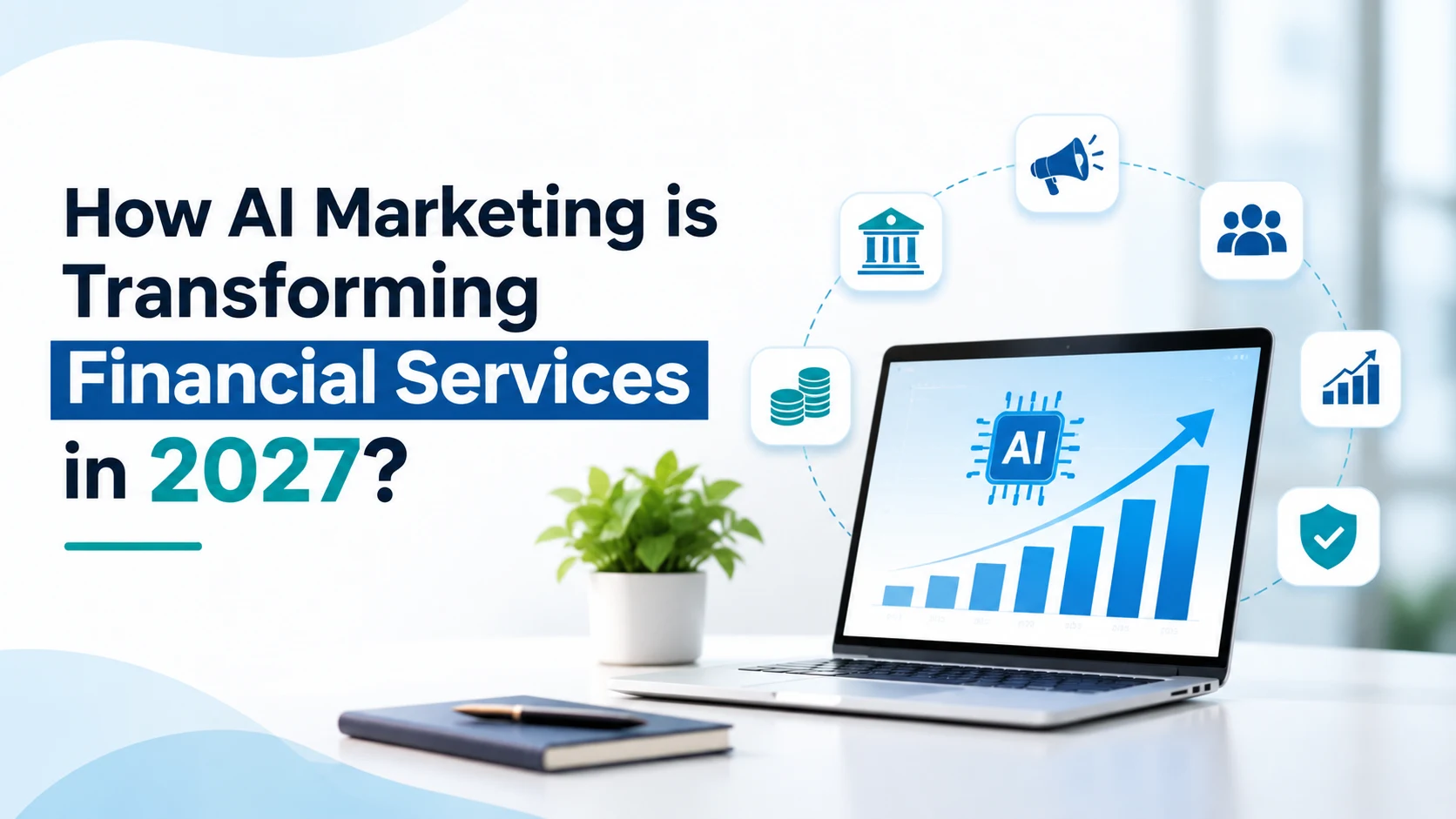
AI marketing is transforming financial services in 2027 by enabling financial institutions to:
- Personalize banking and financial communication using customer and Member data.
- Predict customer and Member needs through behavioral analytics and machine learning.
- Improve campaign targeting with data-driven audience insights.
- Strengthen engagement through more relevant, timely, and consistent communication.
The opportunity for change is already here.
According to the 2026 State of Financial Marketing report by Digital Banking Report, 52% of financial institutions have generative AI operational or beyond in their marketing functions. However, 55% are not yet using predictive AI, which can help identify relevant opportunities and guide marketing decisions.
This gap highlights why AI marketing in financial services matters in 2027. Banks, credit unions, and other financial institutions can use AI to better understand customer and member behavior, deliver more relevant communication, and make smarter marketing decisions.
Why Is AI Marketing Transforming Financial Services in 2027?
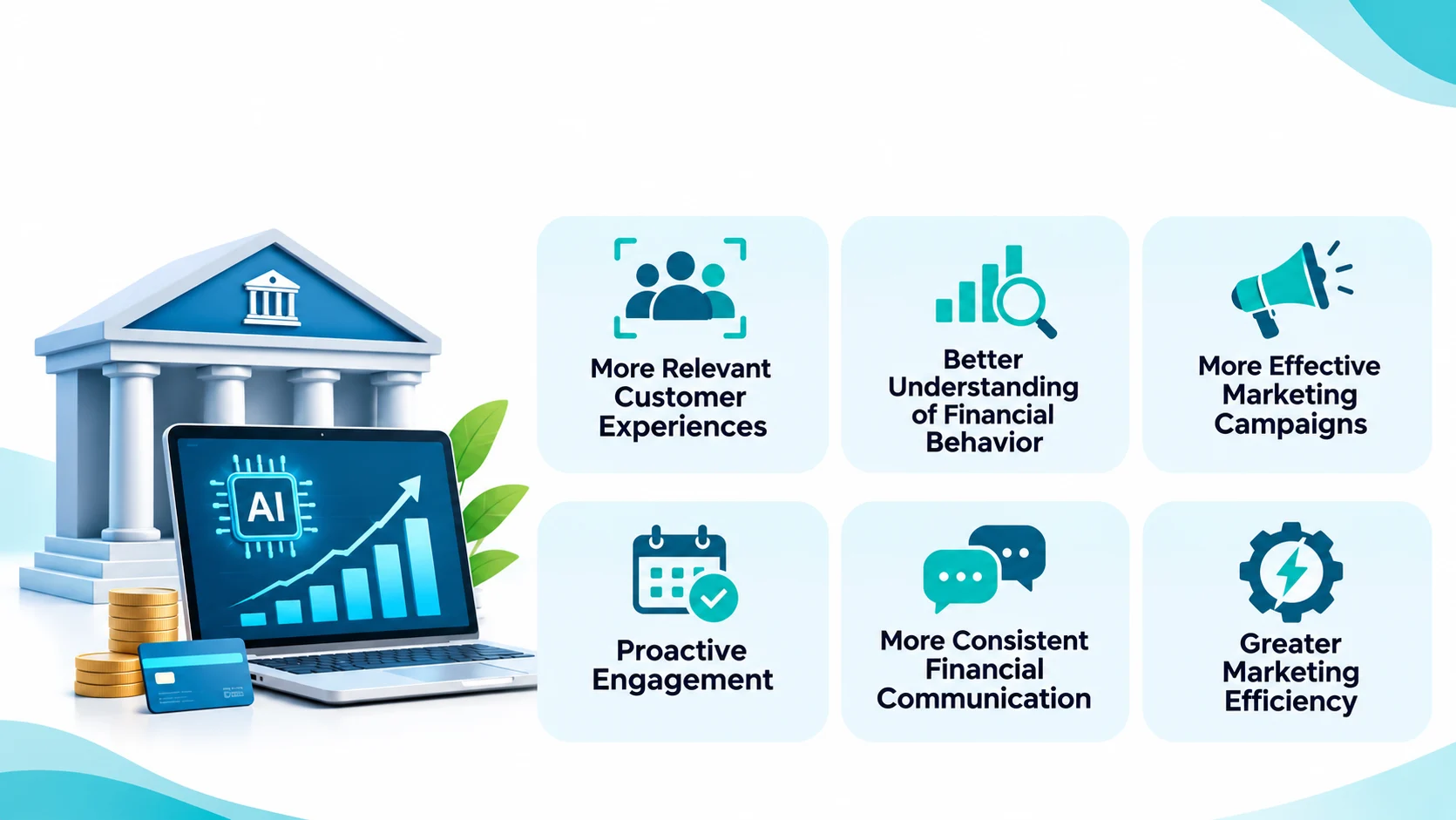
Financial institutions need more than frequent campaigns to build lasting customer and member relationships. They need to understand changing financial needs, recognize engagement opportunities, and deliver relevant communication. AI makes this easier by turning available data into actionable marketing insights.
Here are six reasons AI marketing is becoming important for financial services in 2027.
1. More Relevant Customer and Member Experiences
Customers and members have different financial goals. AI helps reduce generic communication by supporting more personalized product information, financial education, and timely engagement.
2. Better Understanding of Financial Behavior
Disconnected interactions make it difficult to understand what audiences need. AI helps identify behavioral patterns, changing interests, and engagement gaps across available data.
3. More Effective Marketing Campaigns
Broad targeting can result in irrelevant messages and missed opportunities. AI supports better audience prioritization, helping marketing teams make campaigns more relevant.
4. Proactive Rather Than Reactive Engagement
Waiting for customers or members to express a need can mean missing important engagement opportunities. Predictive analytics helps identify potential needs and changing behavior earlier.
5. More Consistent Financial Communication
When communication channels operate separately, customers and members can receive repetitive or disconnected messages. AI-supported coordination helps create more consistent experiences across digital touchpoints.
6. Greater Marketing Efficiency
Manual content creation, campaign analysis, and reporting take time. Generative AI and intelligent automation can support these activities, allowing marketing teams to focus more on strategy and relationship-building.
Ultimately, AI marketing matters because financial institutions need to make better use of the data they already have. The goal is not simply to reach more people, but to make communication more relevant, timely, and valuable.
How AI Marketing Is Transforming Financial Services in 2027?
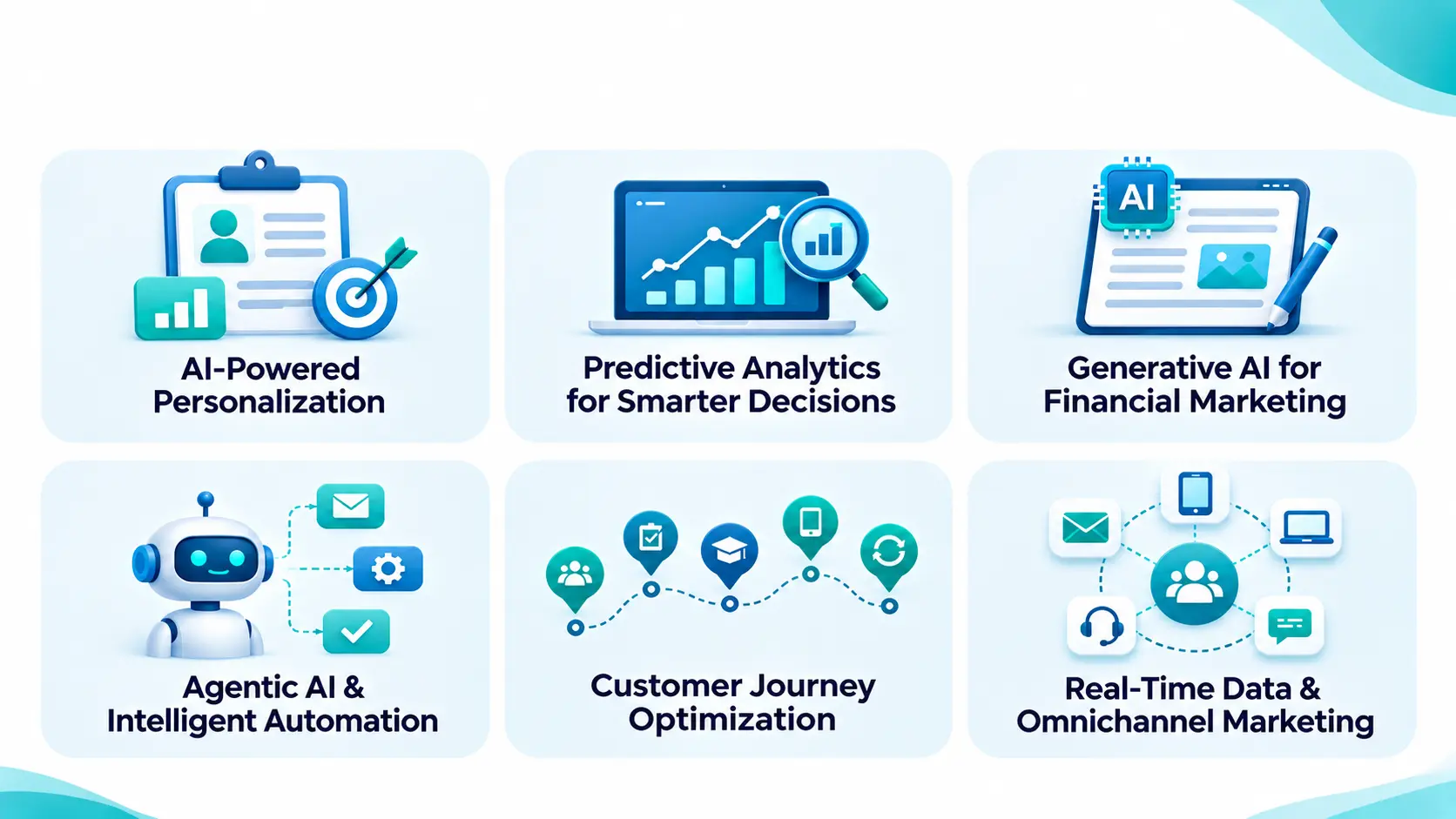
1. AI-Powered Personalization and Hyper-Personalization
Customers and members expect financial communication to reflect their needs, not just their age, income, or account type. Basic segmentation often misses these individual differences.
AI for financial institutions makes personalization more meaningful by analyzing behavioral patterns, preferences, previous interactions, and engagement history. This helps them move beyond sending similar offers to large audience groups.
The difference is important:
- Basic personalization: Sending a home loan email to customers who belong to a particular age group.
- Hyper-personalization: Identifying customers who have shown interest in home financing and sharing relevant loan information or educational content based on their interactions.
For banks and credit unions, this creates opportunities to make communication more timely, contextual, and relevant throughout the financial journey.
2. Predictive Analytics for Smarter Marketing Decisions
Understanding what customers and members need today is important. Recognizing what they might need next can create even better engagement opportunities.
Predictive analytics uses historical data, behavioral patterns, and machine learning to identify possible future actions and interests. It helps financial institutions move beyond past campaign performance and make more informed marketing decisions.
For example, a bank may identify customers showing changing savings behavior and share relevant savings information. Similarly, a credit union may recognize declining digital engagement among certain members and plan timely outreach.
Predictive intelligence can help financial institutions:
- Identify potential customer and member disengagement.
- Recognize changing financial interests and behaviors.
- Identify relevant product and service opportunities.
- Prioritize audiences for marketing campaigns.
- Support next-best-action recommendations.
However, predictions are as good as your data. So, make sure to use high quality, accurate, and appropriate data.
3. Generative AI for Financial Marketing
Creating marketing content for different audiences and communication channels takes time. Generative AI can help financial institutions speed up this process while maintaining consistent messaging.
It can support marketing teams with:
- Email content: Drafting personalized emails for different customer and member segments.
- Campaign variations: Creating different versions of promotional messages for specific audiences.
- Content creation: Developing website copy, social media posts, and financial education content.
- Market research: Summarizing industry trends and customer feedback to support campaign planning.
- Content adaptation: Repurposing existing content for email, mobile apps, websites, and other channels.
For example, a credit union marketing team can use generative AI to create different versions of a financial wellness email for first-time borrowers, existing loan members, and members exploring savings options.
However, AI-generated content still requires human review. Financial accuracy, brand consistency, data privacy, and regulatory compliance must remain priorities.
The real benefit is not replacing marketing teams but reducing repetitive work so they can focus on better campaigns and stronger financial relationships.
4. Agentic AI and Intelligent Marketing Automation
Traditional marketing automation follows predefined rules, such as sending an email after someone opens an account or clicks a campaign link. Agentic AI takes this further by supporting more adaptive, multi-step workflows based on available information and defined objectives.
For financial institutions, this can support:
- Campaign coordination: Managing connected marketing tasks across different channels.
- Intelligent recommendations: Suggesting relevant follow-up actions based on customer and member interactions.
- Campaign monitoring: Identifying engagement changes and potential opportunities for optimization.
- Workflow automation: Coordinating repetitive marketing activities across connected systems.
- Human-led decisions: Escalating sensitive decisions or actions for review and approval.
For example, if a customer shows interest in a bank’s savings products, an AI-supported workflow could help identify relevant educational content, suggest an appropriate follow-up, and coordinate communication through an approved channel.
However, financial institutions still need clear permissions, defined boundaries, monitoring, and human oversight before allowing AI agents to take action.
5. AI-Powered Customer and Member Journey Optimization
A customer’s financial needs change over time. Someone opening their first bank account has different needs from someone exploring a home loan or planning retirement. AI helps financial institutions make communication more relevant at each stage.
It can support better engagement across six important stages:
- Awareness and acquisition: Share relevant product information with potential customers and members.
- Onboarding: Provide timely guidance to help new account holders understand available services.
- Product education: Deliver relevant information about loans, savings, credit cards, and other financial products.
- Digital adoption: Encourage customers and members to explore mobile banking, online services, and digital tools.
- Retention: Identify engagement gaps and support timely, relevant communication.
- Re-engagement: Recognize declining interactions and identify appropriate opportunities to reconnect.
By understanding where someone is in their financial journey, institutions can avoid repetitive promotions and focus on communication that provides value.
6. Real-Time Data and Omnichannel Marketing
Customers and members interact with financial institutions through multiple channels. When these channels operate separately, communication can become repetitive, inconsistent, or irrelevant.
AI combined with connected data helps financial institutions understand interactions across:
- Email: Deliver relevant updates and personalized campaign communication.
- Mobile applications: Share contextual product information and service notifications.
- Websites and online banking: Provide relevant content based on browsing and engagement patterns.
- SMS: Send timely updates through consented communication.
- Contact centers: Help teams access relevant interaction insights for more informed conversations.
For example, if a customer has already explored a bank’s loan options online, the institution can provide relevant follow-up information instead of sending another generic promotion.
However, effective omnichannel marketing depends on accurate data, connected systems, communication preferences, and appropriate consent.
How Different Financial Institutions Can Use AI Marketing?
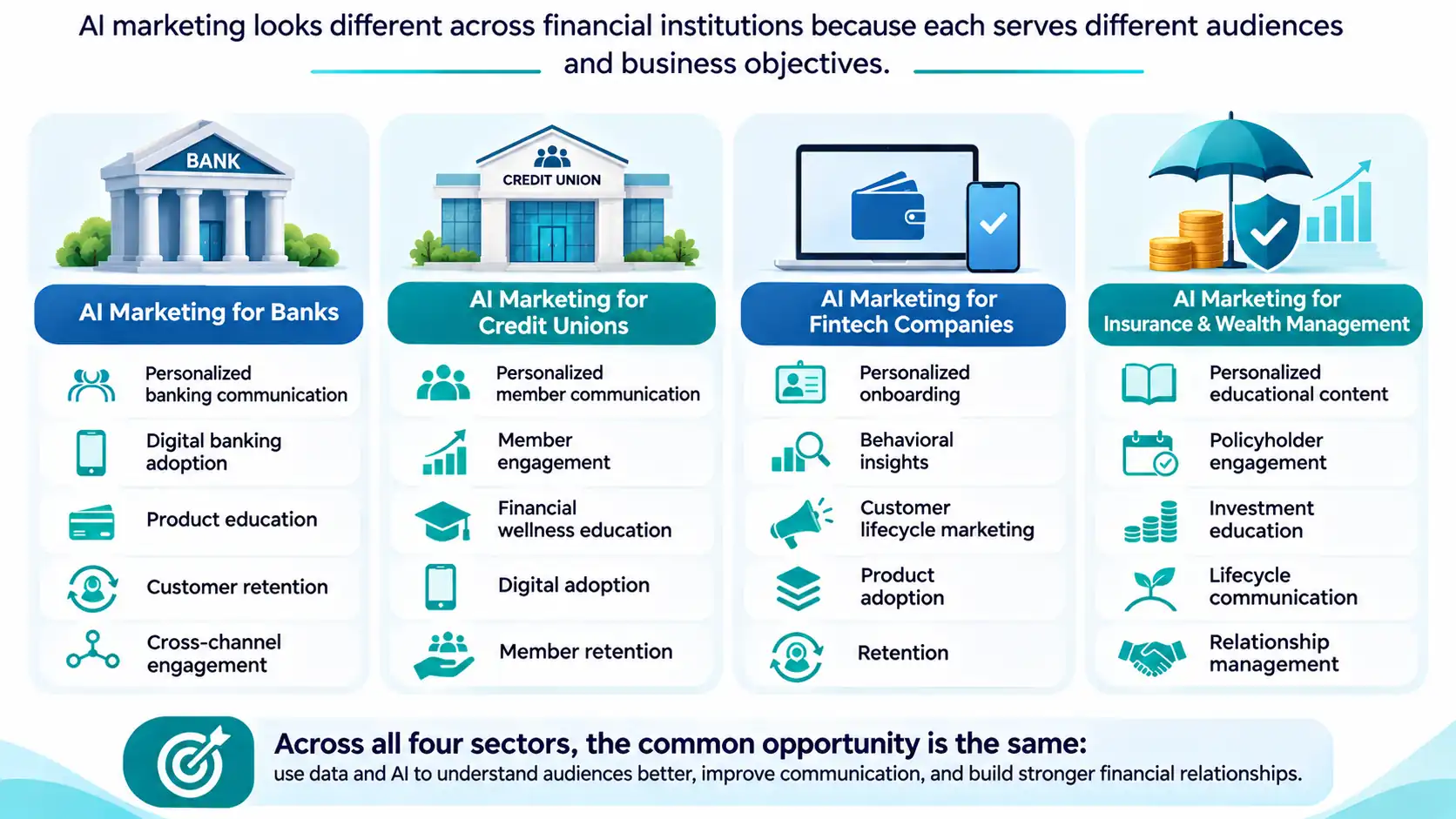
AI marketing looks different across financial institutions because each serves different audiences and business objectives. Banks focus on customer relationships, credit unions prioritize member engagement, while fintech companies and insurance providers have their own marketing needs.
1. AI Marketing for Banks
AI for banks helps them understand customer behavior, improve product awareness, and deliver more relevant banking communication.
- Personalized banking communication: Share relevant savings, lending, and banking information based on customer interests.
- Digital banking adoption: Identify opportunities to encourage customers to use mobile apps and online banking services.
- Product education: Deliver relevant information about loans, credit cards, deposits, and other banking products.
- Customer retention: Recognize potential disengagement patterns and support timely outreach.
- Cross-channel engagement: Maintain consistent communication across email, websites, mobile apps, and other channels.
2. AI Marketing for Credit Unions
AI for credit unions can strengthen member relationships by making communication more relevant to individual financial needs.
- Personalized member communication: Share relevant financial products, services, and educational resources.
- Member engagement: Identify changing engagement patterns and opportunities for meaningful outreach.
- Financial wellness education: Provide relevant content about budgeting, saving, borrowing, and financial planning.
- Digital adoption: Encourage members to explore mobile banking, online services, and digital tools.
- Member retention: Recognize possible disengagement and support timely, personalized communication.
3. AI Marketing for Fintech Companies
Fintech companies operate in competitive, digital-first environments where onboarding, product adoption, and customer retention are important.
- Personalized onboarding: Provide relevant guidance based on customer preferences and interactions.
- Behavioral insights: Understand product usage patterns and changing customer interests.
- Customer lifecycle marketing: Deliver relevant communication at different stages of the customer relationship.
- Product adoption: Identify opportunities to introduce customers to useful features and services.
- Retention: Recognize declining engagement and support relevant re-engagement campaigns.
4. AI Marketing for Insurance and Wealth Management
Insurance and wealth management institutions often maintain long-term relationships that require consistent communication, education, and trust.
- Personalized educational content: Share relevant information about insurance coverage, policies, and financial planning.
- Policyholder engagement: Deliver timely policy updates, renewal reminders, and relevant service information.
- Investment education: Provide educational content aligned with broad customer interests and financial knowledge.
- Lifecycle communication: Adapt messaging to relevant life events, policy stages, and changing financial needs.
- Relationship management: Help teams identify engagement opportunities and maintain consistent communication.
Across all four sectors, the common opportunity is the same: use data and AI to understand audiences better, improve communication, and build stronger financial relationships.
Challenges Financial Institutions Must Consider Before Adopting AI Marketing
AI can help financial institutions improve personalization, campaign targeting, and customer and member engagement. However, successful adoption requires more than choosing the right technology.
Financial institutions must address several challenges before relying on AI for marketing decisions.
1. Data Quality and Integration
Disconnected systems, outdated records, and inconsistent customer information can affect the quality of AI-generated insights. Financial institutions need accurate, reliable, and connected data to support effective marketing decisions.
2. Data Privacy and Security
Financial institutions handle sensitive financial and personal information. Protecting this information requires appropriate access controls, secure data handling, and clear policies governing how information is collected and used.
3. Regulatory and Compliance Considerations
AI-generated marketing communication must align with applicable financial regulations, privacy requirements, advertising standards, and communication consent rules. Human review is particularly important when campaigns involve financial products or potentially sensitive decisions.
4. AI Bias and Transparency
AI models can reflect biases present in their training data or underlying information. Financial institutions need to monitor model outputs, understand how recommendations are generated, and identify potential unfair treatment.
5. Human Oversight
AI can support campaign planning, audience analysis, and content creation, but it should not replace human accountability. Marketing teams must review sensitive communication, verify financial information, and approve important decisions.
6. Organizational Readiness
Successful AI adoption requires the right combination of technology, skilled teams, connected data, and clear business objectives. Without proper preparation, even capable AI solutions can struggle to deliver meaningful results.
How Financial Institutions Can Build an AI Marketing Strategy for 2027?
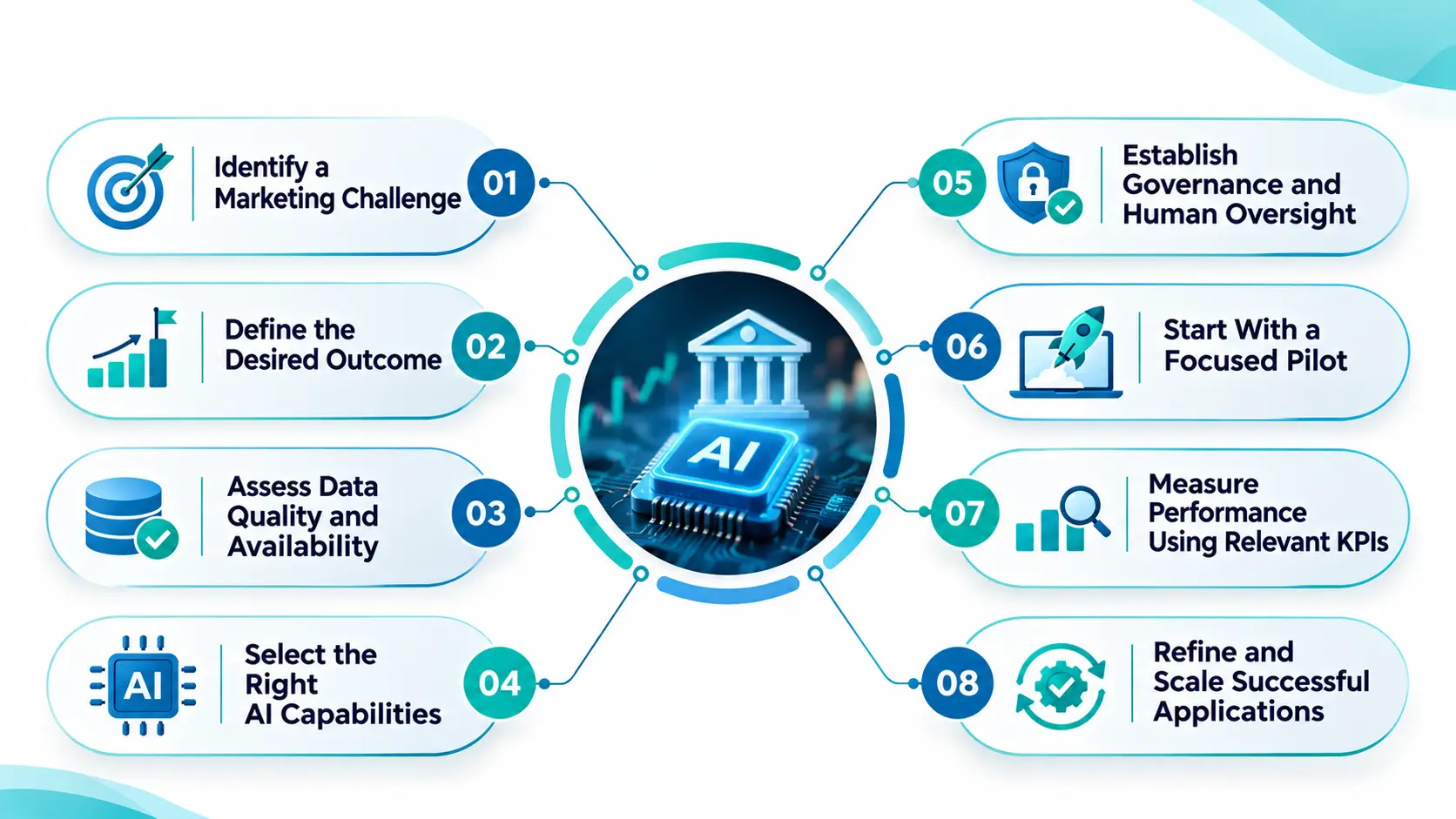
Adopting AI marketing does not require financial institutions to change every marketing process at once. A focused approach helps teams identify the right opportunities, manage risks, and measure results.
Here are eight steps to build a practical AI marketing strategy:
1. Identify a Specific Marketing Challenge
Start with one clear problem, such as low campaign engagement, limited personalization, or declining digital banking adoption.
2. Define the Desired Outcome
Decide what success looks like. This could include better member engagement, improved customer retention, or increased adoption of digital services.
3. Assess Data Quality and Availability
Review existing customer and member information, data sources, system integrations, and permitted data uses before selecting an AI solution.
4. Select the Right AI Capabilities
Choose technologies based on the business objective, whether that involves predictive analytics, generative AI, behavioral analysis, or hyper-personalization.
5. Establish Governance and Human Oversight
Set clear policies for data privacy, model monitoring, content approval, regulatory compliance, and accountability.
6. Start With a Focused Pilot
Test AI in one campaign or engagement initiative before expanding it across multiple marketing functions.
7. Measure Performance Using Relevant KPIs
Track meaningful indicators such as:
- Email open and click-through rates.
- Campaign conversion rates.
- Digital banking adoption.
- Customer and member engagement.
- Customer retention and re-engagement.
- Marketing cost per acquisition.
8. Refine and Scale Successful Applications
Review pilot results, identify gaps, improve the approach, and gradually expand applications that demonstrate measurable value.
The key is to start with a business problem, not the technology. Financial institutions that align AI capabilities with clear marketing objectives are better positioned to build relevant, measurable, and sustainable engagement strategies.
How AiVantage Approaches AI-Powered Marketing?
Financial institutions already have valuable customer and member data. The challenge is turning that information into meaningful marketing decisions and personalized communication.
This is where AiVantage brings together connected data, predictive intelligence, and AI-powered personalization to help banks and credit unions move beyond traditional audience segmentation.
Its InteractiveAI platform focuses on 1:1 hyper-personalization, helping financial institutions create individualized communications based on customer and member behaviors, relationships, and potential needs.
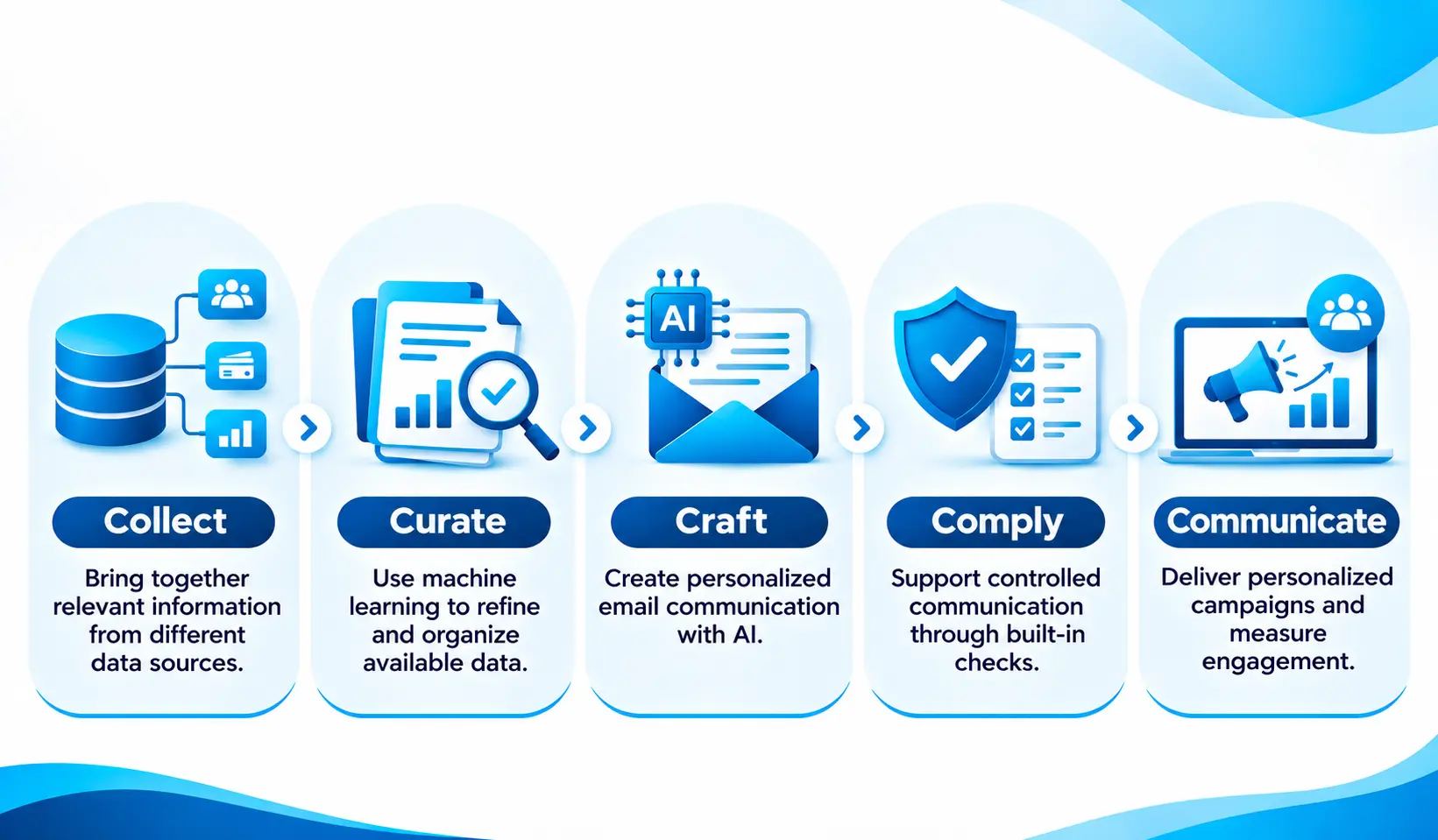
The platform follows a five-step approach:
- Collect: Bring together relevant information from different data sources.
- Curate: Use machine learning to refine and organize available data.
- Craft: Create personalized email communication with AI.
- Comply: Support controlled communication through built-in checks.
- Communicate: Deliver personalized campaigns and measure engagement.
Through this approach, AiVantage aims to help financial institutions turn existing data into more relevant interactions rather than simply sending more marketing campaigns.
Hyper-Personalization for Business Growth+1
For financial institutions looking to make personalization more meaningful, InteractiveAI offers an approach that connects individual insights with personalized engagement at scale.
Conclusion
AI is changing financial services marketing by helping institutions understand customer and member behavior, improve personalization, and make more informed marketing decisions.
In 2027, the real opportunity is not simply to automate campaigns or send more messages. It is to make financial communication more relevant, timely, and valuable. Financial institutions that combine connected data, predictive intelligence, and responsible AI adoption can build stronger relationships and create better engagement experiences.
With its focus on predictive intelligence and 1:1 hyper-personalization, AiVantage can help financial institutions move toward more meaningful, data-driven marketing. The goal is simple: make every interaction count.
Frequently Asked Questions
1. How can banks use AI for marketing?
Banks can use AI to personalize banking communication, improve digital banking adoption, identify customer interests, support product education, and recognize potential retention opportunities.
2. How can credit unions use AI marketing?
Credit unions can use AI to improve member engagement, personalize financial wellness communication, encourage digital adoption, identify changing member needs, and support member retention.
3. How does AI improve financial-services personalization?
AI analyzes available customer and member data, behavioral patterns, and previous interactions to help financial institutions deliver more relevant content, product information, and communication.
4. How can financial institutions measure AI marketing success?
They can track campaign engagement, click-through rates, conversions, digital banking adoption, customer and member retention, re-engagement, and marketing acquisition costs. The right KPIs depend on the campaign objective.